

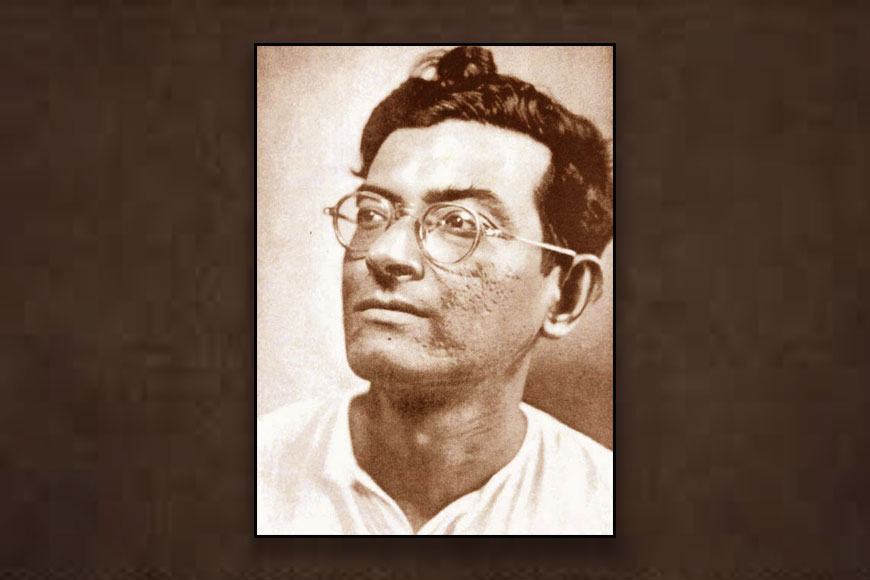
He came as a meteor on the literary scene of Bengal. Manik Bandopadhyay’s reign was brief but intense. His works reflect, in many ways, the turbulent times he was part of and had the opportunity to witness from very close quarters. It was a period of transition, a time when the traditional, long-held values took a severe beating in a post-World War I society that was emerging gradually. There was nothing to hold on to. No concrete scheme was visible in the society of the 1920s and 1930s, but numerous notions were vying for recognition. On the one hand was the effort towards re-orientation of ideas and traditions in a war-ravaged economically and psychologically depraved society; on the other hand, man was increasingly being exposed to novel ideas as psychoanalysis, idealism, materialism etc. The resultant confusion further heightened the intricacies of the time. A product of this era, Manik Bandopadhyay, like his contemporaries, tried to incorporate in his works the widely differing, yet profoundly invigorating spirit of Knut Hamsun, Emile Zola, D.H. Lawrence, Maxim Gorky, Dostoevsky and many others.
Born in 1908 in Dumka in the district of Santhal Parganas, under the Bihar province, India, Bandopadhyay was the 8th born of the 14 children of Harihar Bandopadhyay and Niroda Sundari Devi. His father named him Prabodh Kumar Bandopadhyay. Manik was his pet name that stuck to him permanently. For a brief while, young Manik studied at Kanthi Model School in Tangail. He passed his entrance examination from Midnapore Zilla School in 1926 and got into Welleslyan Mission College at Bankura. In 1928 he passed I.Sc. and came to Calcutta. Here he enrolled for his B.Sc. course in Mathematics at Presidency College and simultaneously stepped into the realm of literature. It opened up a whole new vista for him. During this period, one of his friends in college challenged him to write a short story and Manik took up that challenge. It resulted in writing Atashi Mami, which was published in Bichitra, a famous literary journal of the time. A new author was born in the horizon of Bengali literature.
Bandopadhyay’s tryst with literature was fraught with obstacles right from the word go. His affair with literature affected his result in college. His elder brother, Sudhangshu Kumar Bandopadhyay was very worried and chided Manik, advising him to concentrate on his studies. Young Manik was full of idealism and he was confident that he would be able to survive by taking up writing as a profession. So, in response to his brother’s concern, he left studies midway. His brother was livid and stopped giving him his monthly pocket money. This was the beginning of a new chapter of uncertainty in Manik’s life. He was profoundly influenced by the works of Marx and Engels.
In fact, his eternal quest to come to terms with the question of social reality has often been conditioned by his perception of Marxism. He had, time and again, drawn attention to the influence of Marxism on his orientation. In Lekhaker Katha, he said: ‘After I began to write, my perception on life underwent shifts, but with my introduction to Marxism, I felt the need to change my perspective even more profoundly. I knew that there were numerous imperfections, fabrications and inadequacies in my writing. But before my initiation in Marxism, I did not have the capacity to realise these inadequacies so clearly and intimately.’ In the same article he further noted: ‘Gradually these inadequacies in literature, in man’s practical reality began to torment me. It was anguish born out of conflict. In my own life also this agony was slowly intensifying, and I faced the same situation in my literary efforts too….Marxism has taught me the real nature of this conflict. This conflict was between idealism and materialism.”
Thus, Bandopadhyay’s works need to be looked at from his specific ‘attitude towards life’. Even though he had evolved as a novelist in the course of his literary life, this particular attitude remained more or less unchanged – an interrogation of the different problems confronting his social milieu and an effort to understand them in the light of a theoretical introspection of the prevalent ideas, especially Freudian psychoanalysis and later, Marxian dialectical materialism.



Comments via Facebook