

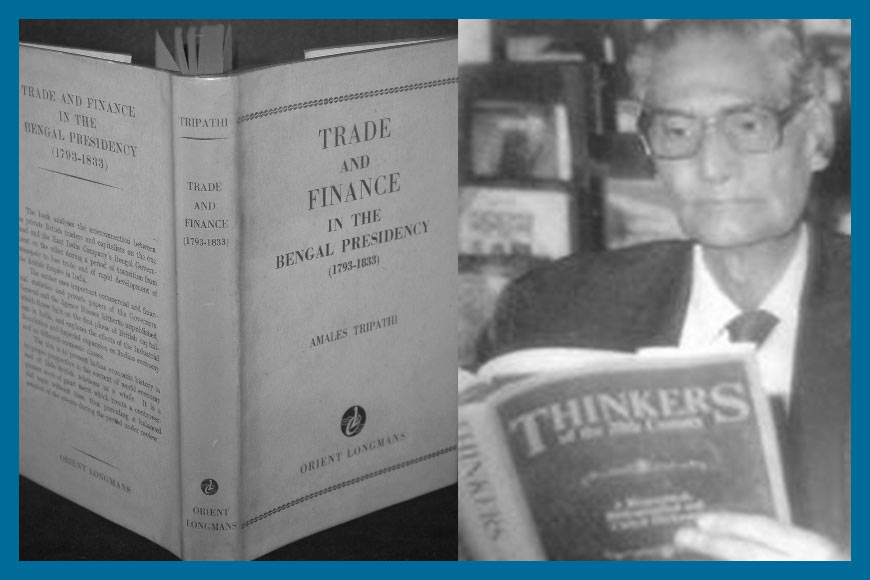
 Author Amales Tripathi
Eminent academician and author Professor Tapan Raychaudhuri in his book Bangalnama says, “Many people speak of his (Nirad Chandra Chowdhury’s) erudition and extraordinary memory. I have seen more erudition than him in Bengalis like Sukhmoy Chakraborty, Ravi Dasgupta and Amales Tripathi.” Eminent historian and highly respected teacher, Professor Amales Tripathi’s birth centenary on February 1, 2021, went by tacitly, unnoticed. However, his pioneering role in different fields of historical research over the years is significant. He initiated the creation of a History Honours curriculum based on modern research and literature. He joined Calcutta University as an Ashutosh Professor in 1969 AD and retired in 1986 AD. In addition to efficient and scholarly teaching during his long career, Tripathi brought about comprehensive development of the infrastructure of the department including the introduction of new courses and appropriate history curriculum in the university. Honoured with the ‘Sir Jadunath Sarkar Gold Medal’, one of the most coveted prizes in appreciation of his important contribution to history, Tripathi was a brilliant teacher and his style of historiography was very special. He introduced new trends in the analysis of the distant past in terms of space and time. His classical taste, factual judgment and originality of interpretation presented history in a unique way as he wrote about the trade of colonial Bengal and freedom struggle; he analyzed it from the perspective of a historian.
Tripathi was born in Devog village near Haldia in East Midnapore district. He was the youngest of his seven sisters and two brothers. His primary education started in the village school established by his father Shyamacharan Tripathi. When he was in the seventh grade, he joined Hamilton High School in Tamluk where his grandfather was a practicing lawyer. A brilliant student throughout, he topped all exams. He took his Matric exam in 1936, aced it with flying colours and was admitted to Presidency College with honours in Economics. In college, his classmates included such eminent personalities like filmmaker Satyajit Ray, politician/Barrister Siddhartha Shankar Ray and former Union Education Minister, Pratap Chandra Chandra. He changed his subject and took admission in Calcutta University with History, and topped his MA exam. After completing his Masters, Tripathi studied law and obtained his law degree in 1945. In 1946, the Government of Bengal nominated him State Scholar. In 1951, Tripathi was off to the US on a Fulbright Scholarship. During his stay there, he researched and published a paper on trade and economy of the Bengal Presidency period 1793 – 1833 AD -Trade and Finance in the Bengal Presidency. In 1954, he obtained his PhD degree from the University of London. His paper was highly praised by Professor Vincent T. Harlow (Beit Professorship of Commonwealth History at the University of Oxford) who acknowledged Tripathi’s work as seminal.
His analytical history of the Congress with a focus on Mahatma Gandhi has much to teach students of contemporary Indian politics. An astute interpreter of trade and finance, he was keenly attentive to the economic context of political movements. “Yet Amales Tripathi was at his best in unravelling for his readers the ideology of Indian nationalism, which he believed was ‘completely misread’ by the so-called Cambridge school because of ‘its lack of understanding of Indian culture’ and by the subaltern collective with its tendency to ‘trivialize’ elite culture. His was a compelling critique of the trends in South Asian historiography that seemed dominant in the 1980s. He would have been happy to note that in the second decade of the 21st century, the history of economic and political ideas is back in vogue. Historians of anti-colonial nationalism today have a much more nuanced approach that Amales Tripathi would have found congenial,” opined Sugata Bose in an article.
In his works, sometimes in the preface of books and during lengthy interviews, Tripathi often raised pertinent issues like; will history be concerned only with the rise and fall of kings and kingdoms? Or, what is the work of historians — to judge or try to comprehend? He emphasized on understanding because understanding makes it easier to forgive. He also studied literature. There was one more thought-provoking question he asked: Is history anthropology? Is history sociology? In Professor Tripathi’s analysis, in the present era, only a reflection of the fragmentary truth will be visible to all. It is the curious mindset of a historian who will delve deep to search and unearth the truth. Historical facts are, in essence, philosophical facts. A few facts are hand-picked as having historical significance from a plethora of information and data. Is there any rule of universal truth behind the selection? The answer, he would say, “None.”


Comments via Facebook