

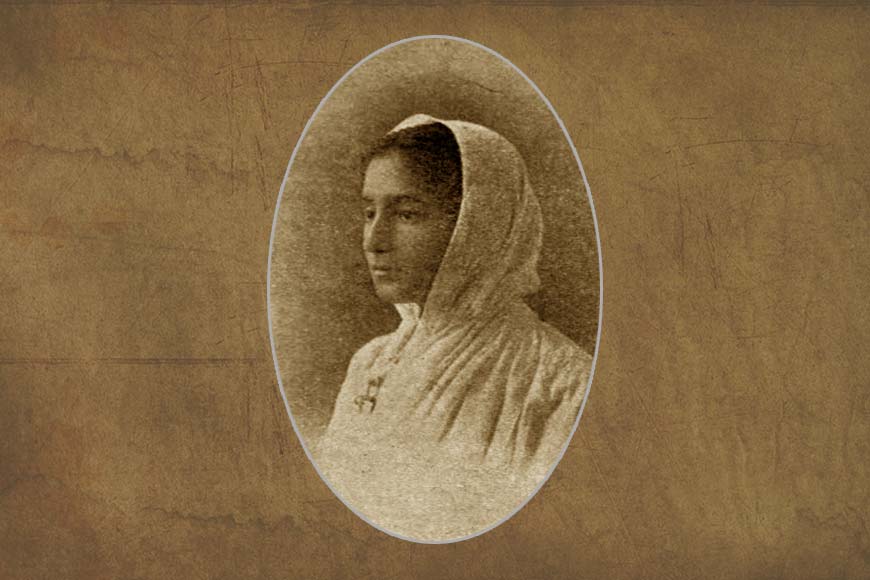
The Tagore family has long been the focus of public curiosity. Like its men, the women of this illustrious family have had a great and enduring influence on the life and people of Bengal. The women of the Jorasanko Tagore family were at the forefront of women’s emancipation in Bengal. Generations of accomplished women of the Tagore household molded Bengal’s distinct ethos and played an important role in the land’s history and culture. One such pioneering lady of the Tagore family was Rabindranath’s niece, Sudakshina Devi aka Purnima Devi. Like the renowned Queen of Jhansi, Rani Lakshmi Bai, she single-handedly took charge of her deceased husband’s vast zamindari estate and executed her duties efficiently for which she was awarded the title of Kaiser-i-Hind Medal by the British Government. She won the esteem of her subjects who regarded her as their ‘Queen.’
Sudakshina took a very keen interest in the education and uplift of women in India. She founded Pandit Jwala Prasad Kanya Pathshala’ at Shahjahanpur in UP in her husband’s memory. She helped in the establishment of the Hewett Model Girls’ School at Muzaffarnagar, United Provinces, and founded Purdah Clubs at Shahjahanpur and Muzaffarnagar to create an exclusive space for the ladies who felt comfortable in their Paurdahs and took measures to improve their status.
The youngest child of Hemendranath Tagore (1844–1884), elder brother of Rabindranath, Sudakshina Devi was born on May 13, 1884, at No. 6, Dwarkanath Tagore Lane, more commonly known as Jorasanko Thakur Bari, the ancestral home of the Tagore family. Like the other women of the Tagore household, Purnima Devi was educated at Loreto Convent, then at a school for European Girls at Park Street, Calcutta, as a day scholar and in addition to English she knew Bengali, Sanskrit, Urdu, Hindi, French, Piano and Violin. She also passed the Cambridge Trinity College Music Examination. Like her other siblings, Sudakshina, too, had a natural flair for writing and her articles were first published in the family-run magazine, ‘Punya’ when she was still in school. However, her creative phase was curtailed and she had to extricate herself and move away from this environment.
Sudakshina’s parents were looking for an eligible groom for their beautiful daughter and zeroed in on Pundit Jwala Prasad Pandey, a very bright and promising Imperial Civil Services (ICS) officer, then posted as Deputy Commissioner of Hardoi, and zamindar of Shahjahanpur, Uttar Pradesh. They were married in 1903. She was the first Bengali lady married in the United Provinces. She was the winner of the B. P. R. A. medal for Diana matches for schooling (1911 Meerut).
Sudakshina life took a sudden turn after this. The vast estate was left without a custodian and acquisitive gold-diggers started looking for opportunities to grab the zamindari. Even the British government attempted to confiscate Shahjahanpur estate but at this point Sudakshina stepped in and resisted her foes single-handedly. She was an expert rider who went around villages on horseback, listening to the woes of her subjects. She proved herself an able administrator and handled and all forms of malpractices, crimes, abuses and discrimination within her estate firmly. She had a band of guards who shadowed her during her expeditions and it comprised a group of fierce armed robbers whose very sight sent tremors down any offender’s spine.
The youngest child of Hemendranath Tagore (1844–1884), elder brother of Rabindranath, Sudakshina Devi was born on May 13, 1884, at No. 6, Dwarkanath Tagore Lane, more commonly known as Jorasanko Thakur Bari, the ancestral home of the Tagore family. Like the other women of the Tagore household, Purnima Devi was educated at Loreto Convent, then at a school for European Girls at Park Street, Calcutta, as a day scholar and in addition to English she knew Bengali, Sanskrit, Urdu, Hindi, French, Piano and Violin.
Sudakshina took a very keen interest in the education and uplift of women in India. She founded Pandit Jwala Prasad Kanya Pathshala’ at Shahjahanpur in UP in her husband’s memory. She helped in the establishment of the Hewett Model Girls’ School at Muzaffarnagar, United Provinces, and founded Purdah Clubs at Shahjahanpur and Muzaffarnagar to create an exclusive space for the ladies who felt comfortable in their Paurdahs and took measures to improve their status. She was the owner of several villages in Shahjahanpur district and built a beautiful house at Nainital (Uttrakhand) called Prasada Bhawan in Abbotsford. One of her sprawling bungalow in Badami Bagh, Srinagar, Kashmir was acquired by the army in 1947 and is now the official residence of the Army Head. She had also got a beach house constructed at Jagannath Dham, Puri.


Comments via Facebook