

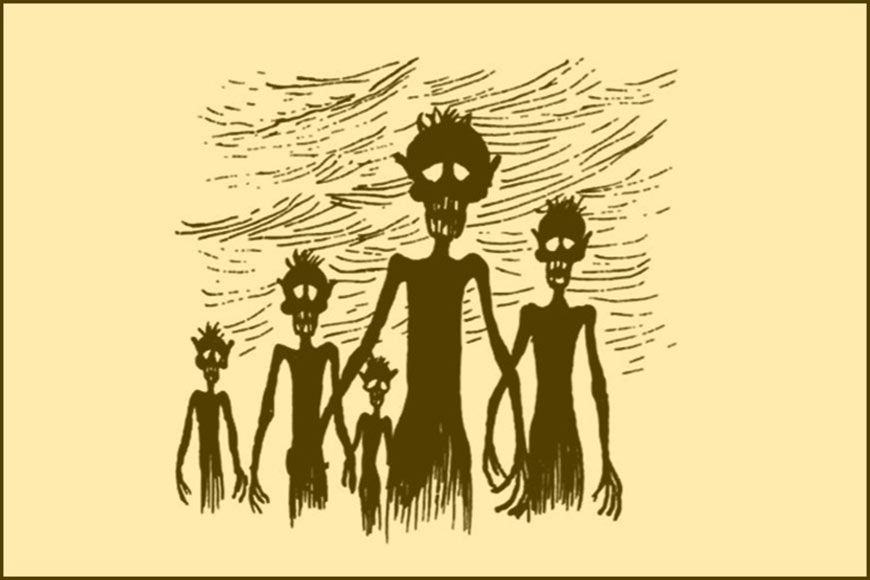
“Bhautik bhitir mul shudhu pratyakkher agochar bastabkayahin sattar astitwa kalpanar hoyni. Praner nissongo ekakittwer moulik asohay bhitir moddhei er bij royechhe. …Nisshahay ekakittwer ahetuk bhiti ei-i bhuter bhoy prabriti anirdeshya atonker bij.”
(Golper Bhut / Sukumar Sen)
Bengali is a born chatterbox. When these three traits meet, they become unparalleled in relishing fear. Whether ghosts exist or not is a meaningless question, what is undeniable is the feeling of fear. And so, on a rainy monsoon evening over fritters, or on a wintry night while playing cards, Bengalis open the Pandora’s box of ghost stories. These tales always begin with solitude: the narrator stranded on a night of torrential rain, or at a deserted, remote railway station; or on the road, a haunted mansion—an old, windowless, doorless two-storied house overgrown with weeds, where the restless spirit makes itself felt through gathering shadows. Such space-time settings themselves are spooky—there may not even be a ghost.
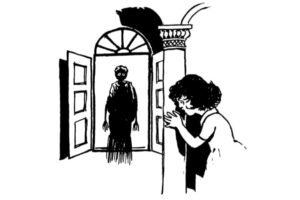
In most Bengali ghost stories, the ghost often is not there at all, and even when it is, it is rarely harmful. Instead, ghosts tend to be emotional, helpful, almost relieved to chat for a while with humans.
Let me tell you one such story—our narrator, weak from fever, is advised by a doctor to seek a change of air. Wondering where to go, he ends up at Hasnuhana Cottage in Madhupur, owned by Sudhanshubabu, a friend of his father. The nameplate of the neglected house has lost its first three letters, so the house is now called Hanakuthi (House of Doom). It was built by Sudhanshu’s father, Sitanshu, who is now dead—a ghost, whose spirit is said still to guard the house. But though a ghost, he is not particularly dangerous. “A ghost, yet a truthful spirit! In some sense, a great soul.” When the narrator, knowing all this, chooses to stay at another house, Sitanshu’s spirit is offended—after all, the narrator is his guest. So in the middle of the night, he drags the narrator back to Hanakuthi. That is the archetypal Bengali ghost. (Modhupurer Hanakuthi /মধুপুরের হানাকুঠি ) by Himanish Goswami).
A second story, however, is not funny at all. The narrator is a medical student. During a trip to North India, the sister and aunt of one of his classmates die in a train accident. By chance, the corpse of that sister ends up at the medical college for dissection. It is the ghost of the aunt who reveals the corpse’s true identity to the narrator, because she wanted her niece to receive a proper funeral. (Mora Katar Bhoye /মড়া কাটার ভয়ে )by Mohonlal Gangopadhyay).




Comments via Facebook